
What is the best fence for windy conditions Latrobe Valley homeowners can choose? It isn’t always the most solid one. A fence that blocks every gust can take the full force of the wind, while gaps and well-supported posts can make a real difference. Get the balance wrong and you may be left with leaning panels, rattling sheets or repairs after a gale.
It’s frustrating when a fence that looked sturdy doesn’t last. Material matters, but so does how the fence is built, from the gaps between boards to the posts and footings holding it in place. Ground conditions and exposure can differ from one property to the next, so a design that suits one block may not suit another.
This guide compares timber and metal fencing options for windy blocks and explains the construction details worth asking about before work begins. You’ll learn how to weigh privacy against airflow, what can make a solid fence more vulnerable, and why post support matters. Use these practical checks to compare options for your property in Churchill, Traralgon, Morwell, Moe or Boolarra.
Key Takeaways
- Wind puts pressure on a fence, and a solid design can catch gusts like a sail.
- Compare Colorbond, timber paling and slat fencing by weighing privacy, airflow and the support each design needs.
- Ask how post depth and ground conditions have been considered before choosing the best fence for windy conditions Latrobe Valley.
- Look out for early signs of trouble, including leaning posts and possible ground-line rot in older timber fencing.
- With Latrobe Heritage Property Services, Dean handles quotes and on-site work directly, without subcontractors.
Understanding the Latrobe Valley Wind Challenge
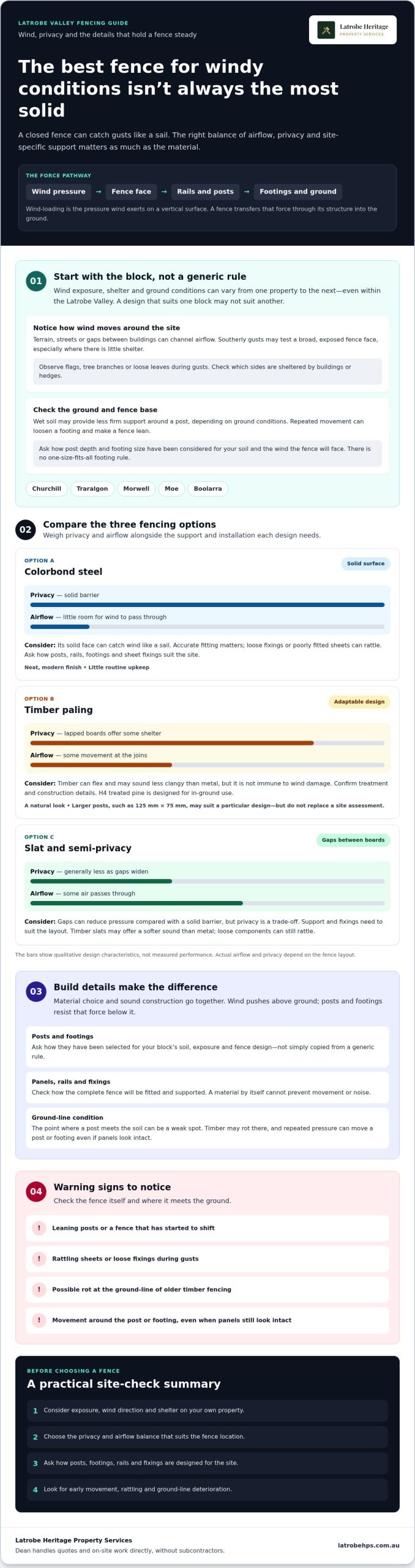
A fence can look solid and still be vulnerable. Wind-loading is the pressure wind exerts on a vertical surface.
A closed fence gives wind little room to pass through. Gusts push against its face, transferring force through the rails and posts into the ground. That’s why the best fence for windy conditions Latrobe Valley depends on more than the material. Exposure, airflow and a stable foundation all matter.
Churchill and Traralgon sit within a region shaped by surrounding ranges. The Latrobe Valley’s unique geography helps explain why wind can behave differently from one block to the next. A “funnel effect” can occur where terrain, streets or gaps between buildings channel airflow. It won’t affect every property in the same way, so assess the conditions on your own site rather than relying on a broad rule.
The Strzelecki Factor: Local Wind Patterns
Southerly gusts can test a fence, particularly when its broad face is exposed and there’s little shelter. Open sections of Moe or Morwell may have less protection from nearby buildings or vegetation than a sheltered suburban yard. That doesn’t mean every open block will fail sooner, but it can mean the fence takes more direct wind pressure.
To get a feel for your block’s prevailing wind direction, observe it over time. Note which way flags, tree branches or loose leaves move during gusts, and check whether buildings or hedges shelter one side of the property. A fencing tradesman familiar with the Valley can help assess those site-specific details.
Soil Conditions and Foundation Failure
Wind pushes the fence above ground, but the posts and footings have to resist that force below it. When soil is wet, it may offer less firm support around a post, depending on the ground conditions. Repeated movement can loosen the footing and make the fence lean.
Check the base first if a fence starts to shift. The ground-line is where posts meet soil, and it can be a weak point. Timber may show rot there, while a post or footing can move under repeated pressure, even when the panels still look intact.
Footing size and post depth shouldn’t be guessed from a generic rule. Soil and exposure vary between properties, even within the Valley. Ask how the installer has allowed for the ground on your block and the wind the fence will face. A site-specific assessment is more useful than assuming the same footing suits every property.
Top 3 Fencing Materials for High-Wind Areas
There’s no single material that suits every windy block. A solid fence can offer privacy, while a design with gaps lets some wind pass through. The right choice depends on exposure, the level of privacy you want and how well the fence is supported. When choosing the best fence for windy conditions Latrobe Valley, weigh the whole build, not just the panel.
Colorbond Fencing: Strong, Solid and Precise
Colorbond steel gives a neat, modern finish and needs little routine upkeep. But its solid surface catches wind like a sail. Poorly fitted sheets or loose fixings can rattle during a storm, so accurate installation matters for stability and noise. On an exposed Churchill block, ask how the posts, rails, footings and sheet fixings will suit the site. The material alone won’t prevent movement or noise.
Timber Paling Fences: Traditional and Adaptable
Timber palings bring a natural look and can be less clangy than metal in gusty weather. Their performance depends on the design. Lapped boards offer some shelter while allowing more movement at the joins than a completely sealed surface. Timber can flex, but that doesn’t make it immune to wind damage. H4 treated pine is designed for in-ground use. Confirm the treatment and construction details rather than assuming every timber component has the same durability. Larger posts, such as 125 mm x 75 mm, may be considered for a particular design, but they aren’t a substitute for assessing the site and footing.
Slat and Semi-Privacy Options
Slat fencing uses gaps between boards to let some air pass through, which can reduce pressure compared with a solid barrier. The wider the gaps, the less privacy the fence generally provides, so there’s a balance to strike. Slats may suit a Traralgon property where a fence faces an exposed or channelled stretch of wind, provided the support and fixings are designed for the layout. Timber slats can offer a softer sound than metal, though any loose component can still rattle.
For broader context, James Cook University’s research on wind loads examines how wind standards inform structural design. The practical lesson is that material choice and sound construction go together. Dean at Latrobe Heritage Property Services personally handles fencing quotes and installations. To discuss timber or metal fencing for your block, explore local fencing options.
Structural Secrets: Why the Build Matters More Than the Material
A strong panel can’t compensate for a weak foundation. Wind pushes against the fence, then transfers force through its rails and posts into the footings and soil. If one part gives way, the whole run can lean or loosen. When comparing quotes, check whether the proposed work explains the post support, rail strength and fixings the design needs. These details can affect how the finished fence performs.
“A fence is only as strong as the hole it sits in.” It’s a useful reminder, not a substitute for checking what the ground and fence design actually require. The best fence for windy conditions Latrobe Valley is built for its site, not from a one-size-fits-all depth or spacing rule.
Post Depth and Foundation Integrity
The “one-third rule” is sometimes used as a rough guide to post depth, but it shouldn’t be treated as a guaranteed specification for Latrobe Valley properties. Soil, fence height, exposure and post size all affect what support is suitable. A standard depth of 600 mm or more can’t be assumed for every block. Confirm the footing design for the actual site.
- Check the ground. Posts need support in firm soil, not just a deep hole through loose or disturbed ground. Wet or soft soil may need a different footing approach.
- Ask about the concrete. The mix and volume need to suit the post, soil and wind pressure. Avoid guessing either detail.
- Discuss the footing shape. A wider base or bell-shaped hole may help resist a post being pulled out, but suitability depends on the ground and design.
These details matter more than simply asking whether a post is “deep enough”. Ask how the installer has allowed for your block’s soil and exposure.
Post Spacing and Rail Strength
Post spacing affects how far rails and panels must span between supports. Shorter spans can reduce the load each section carries and help limit bowing, but the right spacing depends on the materials and design. For example, a 2.1 m span places supports closer together than a 2.4 m span. Neither measurement is a universal prescription.
Timber fences also need rails that suit the span and palings. A middle rail can help support boards and reduce movement or warping. Galvanised fixings are worth discussing, too. Suitable corrosion-resistant fasteners help keep joints secure as the fence moves in gusts.
Ask how the posts, footings, rails and fixings will work together on your property. A sound build is planned from the ground up, with the design matched to the materials and site conditions.
Warning Signs: Is Your Fence About to Fail?
Wind damage often shows up before a fence comes down. A post that’s starting to lean, a new gap at ground level or panels that clatter in gusts are all reasons to take a closer look. The sooner you spot movement, the easier it may be to work out whether the problem is limited to one section or affecting the fence line.
The “Wobble Test” for Homeowners
After heavy rain, inspect the fence from a safe distance first. Look along the top edge for posts that tilt out of line, and check for gaps between the soil and any visible concrete footing. Don’t push or shake a fence that looks unstable, and keep clear of leaning panels or loose sections. If it moves in the wind or appears unsafe, arrange an assessment rather than testing it by hand.
A slight lean can signal that a post or its footing has begun to shift. More gusts and saturated ground may add stress, so don’t assume the problem will stay minor. Older timber fences also deserve a visual check at the ground-line, where moisture can contribute to rot. Look for soft, damaged or crumbling timber, but avoid probing a post if it seems unstable.
Storm Damage Assessment
After a storm, check for popped nails, loose fixings and Colorbond tek-screws that have backed out. Listen, too. Rattling panels may point to loose sheets or connections, while repeated banging can mean a section is moving against its supports. Noise alone won’t tell you exactly what has failed, but it’s a useful warning to investigate.
Fallen branches can crack palings, bend rails or put force through several posts, even if the fence still looks upright. Check the whole affected run, not just the obvious impact point. Keep people clear of damaged sections, especially where posts have shifted or panels are leaning.
A localised fault, such as one loose fixing or a damaged paling, may be repairable if the surrounding posts and rails remain sound. Widespread leaning, rotten posts or repeated movement may mean more of the fence needs attention. The right call depends on the condition of the whole structure. For a closer guide to timely fixes, read fencing repairs in Churchill.
If your fence is leaning, rattling or showing signs of rot, ask Dean about fencing repairs and what may need attention.
The Latrobe Heritage Approach: Built by Dean, Built to Last
A fence is a practical job, but the person doing the work matters. At Latrobe Heritage Property Services, Dean personally handles each quote and installation. There’s no hand-off between the person who discusses the job and the tradesman on site. You can speak directly with the person responsible for the posts, rails and finished fence.
Dean uses no subcontractors. The best fence for windy conditions Latrobe Valley isn’t a standard design copied from one block to another. Exposure, shelter, ground conditions, privacy and the look of your home all help shape the right choice.
Local Knowledge, Local Pride
Dean works in Churchill, Traralgon, Morwell, Moe and Boolarra. Local experience can help identify site details a generic recommendation may miss, such as an exposed boundary or a section sheltered by neighbouring buildings. You can explain what your fence needs to do and discuss materials and construction choices directly with the business owner.
Good work shouldn’t be rushed. Take time to understand what’s included in the quote and how the proposed fence suits your property. Council requirements can vary with fence location and height, so check the current rules that apply to your block before work begins. Don’t rely on assumptions or a general rule of thumb.
Your Next Steps for a Sturdier Home
Start by noting which parts of your boundary feel most exposed, where gusts seem to funnel, and whether you want a solid screen or some airflow through the fence. Share those details when discussing the job. Ask how the recommended style, posts, footings and fixings suit the conditions on your property. A clear conversation helps you compare options without choosing on appearance alone.
Dean personally handles quotes and installations, so you can discuss the work directly with him. Ask for a quote that clearly sets out the proposed fencing, materials and relevant work, then consider how the design balances durability, privacy and the character of your home.
For fencing advice for your Latrobe Valley property, organise a fencing quote with Dean.
Choose a Fence You Can Rely On
A dependable fence starts with a design that suits your block, followed by careful construction and solid support. The right material matters, but so do wind exposure, posts and fixings. Those are the details to consider when choosing the best fence for windy conditions Latrobe Valley.
With Latrobe Heritage Property Services, Dean personally quotes and installs the fence. There are no subcontractors, and Dean is a fully insured local operator. You deal directly with the person responsible for the work, from the first discussion through to installation.
Ready to talk through a fencing option for your property? Get a fencing quote from Dean. Discuss your block’s exposure, the privacy you want and the support the design will need.
Frequently Asked Questions
What is the best material for a fence in a high-wind area?
There isn’t one best material for every high-wind block. Slat fencing allows some wind through its gaps, while Colorbond offers a solid screen that needs sound support and careful installation. Timber paling is another option, with its performance depending on the layout and construction. For the best fence for windy conditions Latrobe Valley, consider your block’s exposure, desired privacy and soil, not just the panel material. Conditions can differ between Churchill, Traralgon, Morwell, Moe and Boolarra.
How deep should fence posts be buried in the Latrobe Valley?
There’s no single post depth that can be recommended for every Latrobe Valley property. The suitable depth depends on factors such as the fence design, ground conditions, post size and wind exposure. Wet or loose soil may need particular consideration. Ask the installer to explain how the post and footing plan suits your block rather than relying on a general rule such as one-third of the post being buried. Don’t treat a standard measurement as a guarantee of stability.
Will a Colorbond fence blow over in a storm?
A Colorbond fence won’t automatically blow over in a storm, but its solid surface catches wind. Its ability to withstand gusts depends on the overall design and installation, including the support posts, footings, rails and fixings, as well as the site’s exposure. After a storm, look from a safe distance for leaning posts, loose sheets or rattling panels. If anything appears unstable, keep clear and have the fence assessed before attempting repairs.
Is a timber fence better than metal for windy conditions?
Not necessarily. Timber and metal can both suit windy conditions when the fence is designed and installed to match the site. A timber paling fence may have some movement at board joins, while solid metal fencing can catch more wind and may rattle if components are loose. Consider how much privacy and airflow you want, then ask how the posts, rails and fixings will support that design. The material alone doesn’t determine how the fence will perform.
Can I repair a fence that is leaning due to wind?
Sometimes, but first find out why it’s leaning. The issue could be limited to a damaged section, or it may involve a shifted footing, weakened post or movement along the fence line. Don’t push, shake or try to straighten a fence that looks unstable. Keep people clear and arrange an assessment. Dean at Latrobe Heritage Property Services personally handles quotes and on-site work in the Latrobe Valley.
How much does it cost to wind-proof an existing fence?
The cost depends on what needs attention, so there isn’t a reliable price without assessing the fence. A loose fixing, a damaged section and a fence with leaning posts or weakened footings involve different work. A tradesman can inspect the fence and explain whether targeted repairs or broader work may be needed. Latrobe Heritage Property Services provides free quotes, with Dean personally handling the assessment and quote for properties in the local service area.
Does slat fencing really help with wind resistance?
Slat fencing can reduce wind pressure compared with a solid fence because air can pass through the gaps. The result depends on the slat spacing, fence layout, exposure and supporting structure. Wider gaps allow more airflow but usually mean less privacy, so weigh that trade-off before choosing a design. If your property has an exposed boundary or a spot where gusts seem channelled, ask an installer how a slat fence would be supported on that particular section.
What should I do if my fence is rattling in the wind?
Check the fence from a safe distance and look for loose sheets, fixings or rails, and posts that have started to lean. Rattling can point to movement in a connection, but the sound alone won’t show whether the issue is local or affects a wider section. Don’t climb on the fence or handle loose parts if it seems unstable. If the noise continues or you see damage, arrange an assessment before the next strong gust.