
Your fence shouldn’t be a part-time job. In the Latrobe Valley, the heavy Gippsland clay is famous for turning straight post lines into leaning eyesores within a single season. If you’re tired of gates that won’t latch or wire that sags the moment the temperature drops, you aren’t alone. Getting rural fencing Latrobe Valley right means understanding the ground beneath your boots. It requires a “built-once, built-right” philosophy. No shortcuts. No excuses. Just honest, local craftsmanship that respects the landscape.
I know how frustrating it is to invest your hard-earned money only to see posts shifting after the first big storm. You want a boundary that’s solid, secure, and smart. This guide will show you the most durable and cost-effective rural fencing solutions tailored for our specific Gippsland climate in 2026. We’ll cover everything from high-tensile wire longevity to the latest council regulations. You’ll learn which materials actually suit your livestock and how to avoid the trap of unreliable subcontractors who disappear when the real work begins. It’s about getting clear advice from a local who actually does the work himself.
Key Takeaways
- Understand why the heavy Gippsland clay requires specific installation techniques to prevent your posts from shifting or leaning over time.
- Compare the safety benefits of classic timber post and rail with the versatility of wire mesh for different livestock and land use needs.
- Learn how to map your lines and position gates effectively to ensure easy vehicle and stock access across your entire property.
- Discover why dealing directly with an owner-operator is the most reliable way to secure quality rural fencing Latrobe Valley.
- Get practical advice on navigating local council regulations and Victorian fencing laws to avoid costly boundary disputes with neighbours.
Why Rural Fencing in the Latrobe Valley Requires a Local Approach
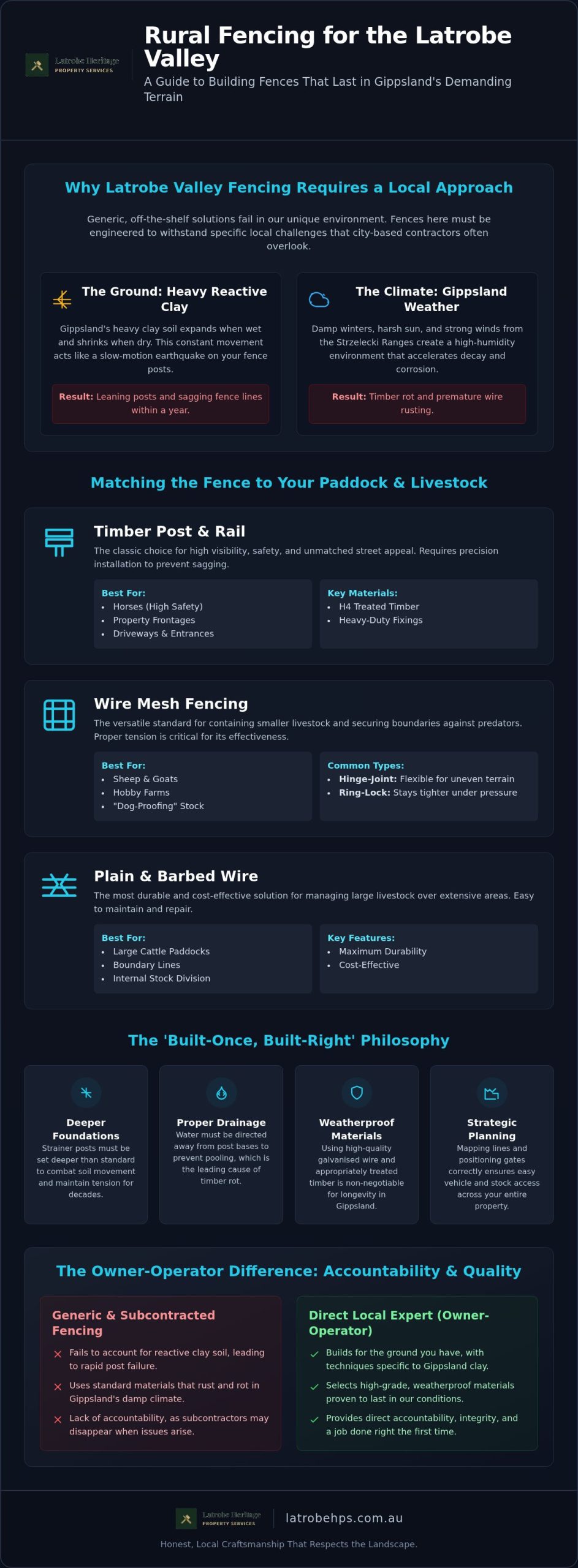
Latrobe Valley land isn’t just any paddock. It is a unique Gippsland environment with its own set of rules. We deal with specific challenges that city-based contractors simply don’t understand. The wind coming off the Strzelecki Ranges hits our boundaries hard. Our summer sun bakes the ground until it cracks. Then the winter rains turn everything into a bog. If you buy a generic kit from a big-box store, it won’t last. You need rural fencing Latrobe Valley landowners can actually trust to stay upright through every season.
Our soil is reactive. It is heavy clay. When it is wet, it expands. When it is dry, it shrinks. This constant movement is a fence killer. If your posts aren’t deep enough, they will lean within twelve months. In places like Boolarra or Yinnar, the undulating hills add another layer of difficulty. You can’t just run a straight line and hope for the best. You have to account for the contours and the way water moves across the surface. To see how professional hardscaping can solve similar terrain issues, you can learn more about Landscape By Design Of Palmetto. A local approach means building for the ground you actually have, not the ground you wish you had.
Navigating Local Soil and Terrain
Heavy clay soil is the biggest hurdle for rural fencing Latrobe Valley projects. It acts like a slow-motion earthquake. Standard post depths that work in sandy coastal soils will fail here. I ensure every strainer post is set to handle the tension and the ground movement. Proper drainage is also vital. If water pools at the base of your timber posts, they will rot out before the decade is up. We build to let the water move away, not soak in. Whether you are on the flats or the slopes of the valley, the foundation determines the life of the fence.
Weatherproofing Your Boundaries
Gippsland winters are notoriously damp. That moisture gets into everything. Using high-quality galvanised wire isn’t a luxury; it is a requirement. When looking at Agricultural fencing options, you have to choose materials that handle high humidity without rusting. I use treated timber that stands up to the wet. We don’t cut corners on the coating. A cheap roll of wire might look the same on the shelf, but it will be brittle and rusted in five years. Local knowledge means knowing which materials survive the frost and the gales. When a Gippsland storm does bring down a section of timber fencing, having a clear plan matters — our timber fence repair Churchill checklist walks you through exactly how to assess the damage and decide what can be saved.
Generic, off-the-shelf solutions fail because they are designed for the “average” Australian backyard. The Latrobe Valley isn’t average. It is demanding. A fence here needs to be a fortress against the elements and the livestock. Dealing with a local bloke who does the work himself means these details aren’t overlooked. It’s about accountability, integrity, and a job done right the first time.
Standard Rural Fencing Options: From Post and Rail to Wire Mesh
Choosing the right setup isn’t just about the price tag. It’s about what you’re trying to keep in; or keep out. For rural fencing Latrobe Valley properties, we see everything from 100-acre cattle runs to 5-acre hobby farms. Each requires a different build style to remain effective over the long haul. Getting the right rural fencing Latrobe Valley residents need means matching the material to the animal and the specific layout of the land.
The Enduring Appeal of Post and Rail
Timber post and rail is the classic choice for a reason. It defines a property. I often install this around driveways and front boundaries in Churchill and Traralgon because it offers unmatched street appeal. For horse owners, it’s about safety. Horses see a solid rail much better than a thin wire. To make it last, I use high-grade H4 treated timber to resist the damp Gippsland ground. Keeping those rails straight requires precise drilling and heavy-duty fixings. It is a slow process, but it is the only way to prevent sagging over time.
Modern Wire Solutions for Stock and Security
If you’re running sheep, goats, or smaller livestock, wire mesh is the standard. You’ll usually choose between hinge-joint and ring-lock mesh. Hinge-joint is more flexible for uneven ground, while ring-lock stays tighter under pressure. Properly planned boundaries are the first line of defence for biosecurity and fencing on Victorian farms. In our region, “dog-proof” mesh is becoming more popular to protect stock from roaming predators. The secret isn’t just the wire; it’s the tension. Without the right strain, even the best mesh becomes a tangled mess in the Gippsland clay.
For larger cattle paddocks, traditional plain wire or barbed wire remains the most cost-effective option. It is durable and easy to repair. If you need to manage internal grazing, consider these options:
- High-tensile plain wire: Best for long, straight boundary lines.
- Barbed wire: Provides an extra level of deterrent for stubborn cattle.
- Electric offsets: A great way to keep stock off your main fence and extend its life.
I handle every part of the install myself, so the tension is always spot on. If you’re ready to upgrade your rural fencing Latrobe Valley property, I can help you plan your boundaries to suit your land perfectly. I don’t use subcontractors, so you’ll know exactly who is doing the work from start to finish.
Matching Your Fence to Your Paddock: Livestock and Land Use
A fence is more than a line on a map. It is a tool for managing your land. For rural fencing Latrobe Valley landowners, the first step is defining the job that fence needs to do. Boundary fences have one goal: security. They keep your stock in and your neighbours’ stock out. Internal fences are different. They are about grazing rotations, animal separation, and ease of movement. I see many folks on smaller hobby farms over-invest in internal lines while neglecting the perimeter. I always recommend spending your budget where the risk is highest. A failed internal fence is a nuisance. A failed boundary fence is a legal liability.
The needs of a ten-acre hobby farm in Churchill are worlds away from a large cattle run in Traralgon. On larger properties, you might save costs by using high-tensile plain wire for internal paddocks. On smaller blocks, the focus shifts to aesthetics and high-density stock management. Whether you are running a few sheep or a full herd of cattle, the build must match the pressure. Cattle will rub. Sheep will lean. Your fence needs the strength to push back without snapping or sagging.
Fencing for Horses and Hobby Farms
Horses are flighty animals with poor depth perception. They don’t just see a fence; they run into it. Safety, visibility, and security are the three pillars of a good horse paddock. I never recommend barbed wire for horses. It causes horrific, life-changing injuries. Instead, use timber top rails or high-visibility electric tape. These options make the boundary obvious. I also suggest creating laneways between paddocks. Laneways make moving animals stress-free and prevent stock from getting cornered. It’s about creating a safe environment where you don’t have to worry every time there’s a thunderstorm.
Boundary Security and Predator Control
Your perimeter is your first line of defence. In Victoria, the law expects a “sufficient” fence between neighbours. Usually, this means a standard 1.2-metre post and wire build. But “sufficient” doesn’t always stop local pests. If you are near bushland in the Strzelecki foothills, you might deal with foxes or wombats. Apron mesh is a practical solution here. It lies flat on the ground at the base of the fence to stop animals burrowing under. It’s a simple addition that provides massive peace of mind. A sturdy, well-planned boundary is the best way to avoid midnight phone calls about wandering stock on the road. I build these lines to last, using heavy-duty strainers that stay put in the Gippsland clay.
Planning Your Build: Strainer Posts, Gates, and Ground Clearance
A reliable fence starts long before the first post is driven into the ground. I don’t just turn up and start digging. Proper rural fencing Latrobe Valley projects require a methodical approach to ensure the finished product is straight, strong, and secure. Skipping the planning phase is a recipe for sagging wires and hit services. I follow a strict four-step process for every build to guarantee a result that lasts for decades.
- Step 1: Mapping and Services. I always identify underground pipes and cables first. I don’t guess. I use the “Before You Dig” service to keep everyone safe and avoid costly repairs to water or gas lines.
- Step 2: Gate Placement. Think about your stock flow and vehicle access. I recommend placing gates on high ground to avoid the Gippsland mud. We ensure there is enough swing room for your largest tractor or mower.
- Step 3: Material Selection. We choose strainer posts based on your specific tension needs. Whether it is heavy-duty treated timber or galvanised steel, the material must match the job.
- Step 4: Line Clearing. A straight fence is a strong fence. I clear away old wire, fallen branches, and thick scrub to create a clean path for the new build.
The Importance of Quality Strainer Posts
A strainer post is the critical tension point for any wire fence. It is the anchor. If the strainer moves, the whole line fails. In the Latrobe Valley, I often favour heavy-duty treated timber strainers because they offer better grip in our reactive clay. Steel strainers are excellent for fire-prone areas but require expert installation to prevent lifting. I don’t use undersized posts. I don’t use shallow holes. Every anchor I install is designed to hold the strain of high-tensile wire through summer heat and winter wet.
Gate Installation and Repairs
Gate sag is the number one complaint I hear from local landowners. It usually happens because the hinges are too small or the brace is weak. I use heavy-duty, adjustable hinges that allow for minor ground shifts. For Churchill residents, common rural gate repairs often involve fixing gates that have become bogged or hard to open due to poor initial drainage. If you are also dealing with leaning posts or damaged sections along your boundary, professional fencing repairs Churchill VIC homeowners can rely on will save you from a costly full replacement. I build gates that stay level. I build them to open with one hand. If you need a hand getting your property boundaries sorted, you can book a site visit for rural fencing today. I handle every quote and every install personally; no subcontractors, no excuses.
The Latrobe Heritage Difference: Reliable Fencing Without the Subbies
When you hire someone for rural fencing Latrobe Valley, you expect to see the person you spoke with on the phone. Too often, large companies send out subcontractors. These workers are often rushed. They are paid by the metre. They don’t have a personal stake in the longevity of your property. I don’t work that way. I am an owner-operator. I handle every quote personally. I do every bit of the on-site work myself. There is no middle-man. There is no call centre. Just me, my tools, and a commitment to your land.
I am fully insured and based right here in Churchill. I know the local area. I know the people. Choosing me for your rural fencing Latrobe Valley project means choosing peace of mind. You aren’t just another number on a spreadsheet. You are a neighbour. I stand by every fence I build and every gate I hang. That is my personal guarantee. No excuses. No shortcuts. Just a job done right.
Old-School Craftsmanship Meets Modern Reliability
I value quality over speed. I take the time to set every post correctly. I don’t cut corners to get to the next job. Communication is direct and honest. If a problem comes up, we talk about it right there in the paddock. You get a sturdy finished product. You get a clean site. I don’t leave old wire or offcuts for you to clean up. It is about respect. Respect for your time. Respect for your property. Respect for the trade. I take pride in the details that others often miss.
More Than Just Fencing
A new fence is often just one part of a bigger property plan. I support your whole property through Latrobe Heritage Property Services. Beyond fencing and gates, I handle lawn care and garden maintenance. I can integrate these services to keep your acreage looking its best all year round. Whether you need a boundary secured or a garden bed tidied up, the standard remains the same. Professional. Reliable. Local. For those interested in broader landscape health and irrigation, you can learn more about Green Earth, LC and their approach to sustainable solutions. Dealing with one person for multiple jobs saves you time and stress. You know the work will be done right every single time.
If you’re ready to get your land in order, Ask Dean for a free quote on your rural fencing project today. I’ll come out, look at your land, and give you a straightforward price with no hidden fees.
Secure Your Gippsland Property Boundaries Today
Your land is a significant investment. It deserves a boundary that stands firm against the unique challenges of our region. We’ve explored how the reactive Gippsland clay and the gales off the Strzelecki Ranges demand a built-once, built-right philosophy. Whether you’re running cattle near Traralgon or setting up a horse paddock in Churchill, the right rural fencing Latrobe Valley solution is about more than just wire and wood. It’s about careful planning, deep-set strainer posts, and gates that actually stay level through the winter mud.
I don’t believe in cutting corners or passing the buck. When you work with me, you get a dedicated professional who handles every quote and every installation personally. There are no subcontractors. There are no call centres. There are no excuses. I’m a local owner-operator, fully insured, and I take genuine pride in every post I drive into the ground. Let’s build something that lasts. Get a free, no-obligation quote from Dean at Latrobe Heritage Property Services today. Get the peace of mind that comes from dealing with a man of his word.
Frequently Asked Questions
How much does rural fencing cost per metre in the Latrobe Valley?
Rural fencing costs vary based on your choice of materials and the difficulty of your terrain. For a standard post and wire fence in Victoria, you might expect to pay between A$20 and A$45 per metre for supply and installation. Heavier stock fencing or mesh often ranges from A$40 to over A$100 per metre. I provide clear, transparent quotes so you know the exact cost before I start any work on your land.
Do I need a permit for a rural boundary fence in the Latrobe Valley?
Most standard rural boundary fences in the region do not require a permit if they meet local definitions. A 1.2-metre high post and wire fence is usually permit-free under Latrobe City Council guidelines. Generally, side and rear fences up to 2 metres don’t need a permit. However, corner properties or front fences over 1.5 metres might have different rules. It is always wise to check current local regulations before you begin construction.
What is the best fencing for horses on small Gippsland acreages?
The best fencing for horses prioritises visibility and safety to prevent entanglement or injury. Timber post and rail is the gold standard because it is highly visible and sturdy. If you are on a smaller Gippsland acreage, a combination of plain wire with a timber top rail or high-visibility electric tape works well. Avoid barbed wire in horse paddocks. Safe laneways also help manage animal movement without causing unnecessary stress.
How long does a typical timber post and rail fence last?
A well-built timber post and rail fence typically lasts between 15 and 25 years. This lifespan depends heavily on the quality of the timber treatment and the local soil conditions. In our damp Gippsland environment, using H4 treated timber is essential for posts to resist rot and termites. Regular maintenance, such as checking fixings and clearing vegetation from the base, will help your fence stand straight and sturdy for decades.
Can you repair my existing farm fence or do I need a full replacement?
I can certainly repair your existing farm fence if the main structure remains sound. Sometimes a few new strainer posts or a thorough re-tensioning of the wire is all that is needed to get more years out of a boundary. However, if the majority of the posts have rotted at the ground line, a full replacement is often more cost-effective. I will give you an honest assessment of what is worth fixing. For a closer look at what targeted repairs involve, see our guide to fencing repairs Churchill VIC residents commonly need before committing to a full rebuild.
How do I stop my rural gate from sagging over time?
Stopping a rural gate from sagging starts with a rock-solid strainer post and heavy-duty hinges. The strainer post must be set deep enough to handle the weight without shifting in the reactive clay. Using adjustable hinges allows you to correct minor ground movements later on. A proper diagonal brace on the gate itself is also vital. I build and install gates that stay level and swing freely for years to come.
What is the best way to fence a paddock with heavy clay soil?
Fencing in heavy clay soil requires deeper post holes and careful attention to ground moisture. Clay expands and contracts, which can “heave” posts out of the ground if they aren’t set correctly. I ensure strainer posts are anchored deep enough to resist this movement. Good drainage around the base of the posts also prevents rot. This is a key part of providing reliable rural fencing Latrobe Valley landowners can depend on.
Do you provide fencing services in Traralgon and Morwell as well as Churchill?
Yes, I provide comprehensive fencing and property maintenance services across the entire region. While I am based in Churchill, I regularly work on projects in Traralgon, Morwell, and the surrounding rural areas. Whether you have a small residential block or a larger farming property, I handle the job personally. You won’t have to deal with subcontractors or call centres; you deal directly with a local bloke who does the work himself. If a recent storm has left your timber fencing damaged, our storm damage timber fence repair Churchill checklist can help you assess what needs immediate attention before I come out to take a look.