
A dragging farm gate is almost never just a gate problem. When you need rural gate repairs Churchill acreage throws unique challenges at your fence line, from high-plasticity reactive clays to soaked winter ground. Most people blame a bent pipe frame or a tired hinge, but a drooping gate nose usually points straight to a shifting strainer post or an undersized stay assembly.
Wrestling a heavy steel gate through thick Gippsland mud wastes your time, strains your back, and risks stock pushing through gaps. You shouldn’t have to drag, heave, and force an entrance just to check animals or move machinery. Discover practical methods to diagnose, repair, and reinforce rural gates across Churchill properties to keep paddocks secure without paying for unnecessary full fence replacements. We will examine how to diagnose anchor post movement, correct frame sag with turnbuckles and adjustable gudgeons, and build lasting stability into tough Latrobe Valley soils.
Key Takeaways
- Identify how reactive Latrobe Valley clay soils shrink and swell, levering heavy strainer posts out of plumb.
- Isolate post movement from frame distortion so you avoid paying for an unnecessary gate replacement.
- Learn how turnbuckles, tension wires, and adjustable gudgeon hinges streamline the rural gate repairs Churchill acreage regularly demands.
- Restore smooth latching and stop bottom rails scraping through turf without relying on temporary wire patches.
- Understand why long-term paddock security comes from dealing directly with a hands-on local tradesman who knows regional ground conditions.
Common Rural Gate Faults on Churchill Acreages
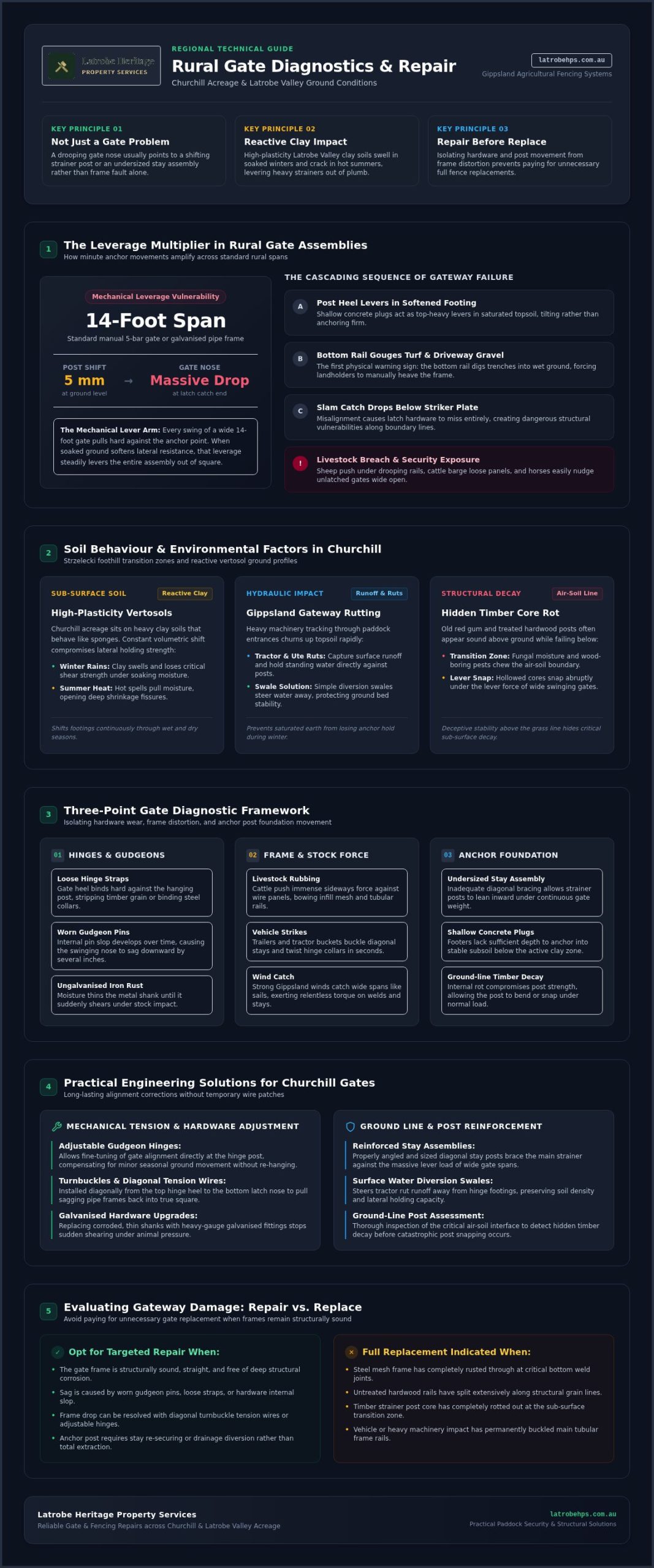
Paddock gates don’t fail by accident. They endure relentless mechanical stress day in and day out. On Churchill hobby farms and grazing acreage, heavy manual five-bar gates and galvanized pipe frames take a constant beating. Wind, weight, and livestock work against them continuously. Farm machinery clips latch posts during busy slasher runs, while strong winds catch wide 14-foot spans like sails. Over time, that relentless leverage takes a visible toll on your boundary lines.
A dragging bottom rail is almost always the first warning sign. When a gate gouges a trench through wet turf or scrapes across driveway gravel, the structure has dropped out of square. This isn’t just an inconvenience that forces you to lift the frame by hand every morning. It’s a genuine security risk. A sagging gate drops the slam catch clean below the striker plate. Once that latch fails to engage, stock quickly exploit the gap. Sheep push beneath the rail, cattle barge through loose panels, and horses nudge gates wide open.
Corrosion and timber fatigue make things worse. Steel mesh frames rust out around bottom welds, while untreated hardwood rails split along grain lines. Practical rural gate repairs Churchill landholders depend on begin with diagnosing whether the fault sits in the hanging hardware, the frame itself, or the anchor post.
The Telltale Signs of Hinge and Gudgeon Wear
Hardware failure happens gradually. Loose hinge straps allow the gate heel to bind hard against the hanging post, stripping timber grain or binding steel collars. Worn gudgeon pins develop internal slop, allowing the swinging nose to sag downward by several inches. When ungalvanised iron fittings sit exposed to damp conditions, rust thins the metal shank until it shears under sudden animal impact.
Physical Impact and Livestock Damage
Stock apply immense sideways force against paddock barriers. Cattle rubbing against wire panels bow the infill mesh and bend tubular pipe rails out of shape. Accidental vehicle strikes from trailers or tractor buckets buckle diagonal stays and twist hinge collars in seconds. Once a frame twists, the latch pin misses the catch completely, leaving stock paddocks vulnerable until the metal is pulled back into line.
Why Rural Gates Shift in Latrobe Valley Soils
Most gate failures don’t originate in the steel frame. They start right beneath your feet. Churchill sits in the transition zone towards the Strzelecki foothills, where paddocks sit on heavy reactive clay soils. These vertosols behave like sponges. When winter rains set in, the clay swells and loses shear strength. Come summer, hot dry spells draw out the moisture, opening up deep shrinkage cracks. This constant expansion and contraction shifts footings relentlessly.
A standard 14-foot farm gate acts like a massive mechanical lever arm on its hinge post. When wet conditions soften the ground, every swing pulls against the anchor point. Even a tiny movement of five millimetres at ground level amplifies into a massive drop at the latch end. Shallow concrete footers often make this worse. Instead of holding firm, a top-heavy concrete plug simply levers through the saturated topsoil, pulling double-drive gates out of alignment and dropping single spans into the dirt. Effective rural gate repairs Churchill acreages require must account for this ground movement rather than simply cranking bolts tighter.
Before spending money on new steel or adjusting hinges, check the ground line. If you need a reliable assessment of your paddock layout, working with Latrobe Heritage Property Services ensures your posts are secured for real local soil conditions.
Gippsland Wet Seasons and Drainage Around Gateways
Heavy machinery tracking through paddock entrances churns up topsoil fast. Tractors and utes create deep ruts that capture runoff, leaving standing water pooled directly against strainer posts. This constant saturation strips the surrounding earth of its lateral holding strength. Digging simple diversion swales to steer water away from gate approaches preserves the ground bed and keeps hinge strainers upright through winter.
Underground Rot and Timber Strainer Decay
Timber posts often play tricks on landholders. An old red gum or treated hardwood post can look rock-solid above the grass line while quietly rotting through at the ground level. Fungal moisture and wood-boring pests chew away the critical transition zone between air and soil. When that timber core hollows out, the heavy lever load of the swinging gate easily snaps the weakened fibres below ground.
Evaluating Damage: When to Repair vs Replace Your Rural Gate
Replacing an entire gateway entrance because the nose drags is throwing good money after bad. In most cases, the gate frame itself remains completely sound. Straightforward mechanical adjustments or minor structural reinforcement can restore smooth operation and add decades of service life to quality galvanised pipe. You only need full replacement when structural integrity is permanently compromised.
Deciding between repair and replacement comes down to separating frame issues from post movement. A bent hinge pin or a loose gudgeon costs very little time to realign. Conversely, attempting to straighten a 25NB pipe frame that has suffered severe vehicle impact or deep structural kinks is rarely worth the labour. Once metal has stretched past its yield point, it loses rigidity and will buckle again under the first gust of wind or animal shove. Sensible rural gate repairs Churchill property owners invest in focus on salvageable assets first, avoiding unnecessary replacements whenever possible.
Step-by-Step Gate and Post Assessment
Take ten minutes to evaluate the physical components before touching a tool:
- Step 1: Strainer Post Plumb: Place a 1200mm spirit level on both the face and side of the hanging post while the gate is closed. Any lean toward the roadway or paddock proves the foundation has slipped.
- Step 2: Hinge Integrity: Check both gudgeons and hinge collars. Look for stripped threads, wallowed-out collar holes, or bent pins.
- Step 3: Rail Alignment: Sight down the top pipe rail from hinge to latch. Check for lateral bowing, twists, or broken internal stay welds.
- Step 4: Latch Clearance: Measure the latch gap. If the pin sits more than 50mm clear of the catch post, the entire span has drifted.
Assessing the Strainer Assembly and Stay System
A gate cannot stay plumb if its anchor system has failed. Inspect the diagonal stay assembly running off the hanging strainer. Timber stay poles must sit firmly against their underground thrust plates without sliding into loose soil. If stay cables have slacked off, or if an old wooden stay block has split underground, the strainer simply tilts under the gate’s dead weight. For major gateway re-builds or comprehensive boundary work, consult an experienced professional; you can review our guide to fencing contractors Churchill for structural boundary standards.
Practical Methods for Correcting Gate Sag and Hardware Alignment
Straightening out a stubborn paddock gate doesn’t require heavy earthmoving gear. It demands the right leverage and durable hardware. For standard rural gate repairs Churchill property owners can restore clean swinging arcs using methodical adjustments. Re-hanging older gates on heavy-duty clamp-on collars gives you immediate height control, lifting dragging rails well clear of thick Gippsland winter mud. When pipe frames take a knock, straightening bent tubing requires slow, controlled bracing with hardwood blocks and mechanical clamps. Forcing metal back too fast cracks factory welds and flakes away protective galvanising.
Re-tensioning Diagonal Truss Rods and Cables
Fitting an internal diagonal tension wire transforms a drooping, tired gate back into a rigid rectangle. Run high-tensile wire from the bottom hinge corner diagonally up to the top latch corner. Fit a heavy-duty galvanised turnbuckle in the centre of that wire run. As you wind the turnbuckle tight, the diagonal tension draws the drooping nose upward without distorting the outer pipe frame. Fasten loose infill mesh with heavy galvanised tie wire to lock that newly squared geometry into place.
Adjusting and Upgrading Field Gate Hinges
Welded fixed strap hinges lock you into one position forever. Swapping them for threaded bolt-through or clamp-on adjustable gudgeons gives you continuous control. Screwing the top gudgeon inward pulls the gate head closer to the post, lifting the nose instantly. Choose long-pin bottom gudgeons to prevent cattle or horses lifting the gate off its mounts when scratching. Packing grease around hinge pins cuts mechanical friction and stops stubborn, noisy gate travel.
Securing the Latch and Slam Assembly
A gate that swings cleanly still fails if the latch doesn’t bite. Flimsy wire loops invite stock escapes. Upgrade to a spring-loaded slam catch or a heavy drop chain bolted squarely to the receiving post. Adjust the striker plate to provide adequate vertical margin, ensuring positive engagement even when seasonal moisture causes minor ground shift. If you want paddock entrances realigned and secured properly, book a farm gate inspection with Dean to get your hardware back in square.
Reliable Gate and Fencing Repairs in Churchill: Deal Direct with Dean
Farm maintenance shouldn’t mean dealing with a rotating crew of strangers or impersonal call centres. When you need rural gate repairs Churchill property owners know that lasting results come down to personal accountability. Latrobe Heritage Property Services operates on a simple, dependable owner-operator model. Dean handles every site assessment, writes every quote, and does all the physical trade work himself.
No sales reps. No third-party subcontractors. No cutting corners. Whether your acreage sits on the rolling ridges of Boolarra, along the valley floor in Yinnar, or out across Traralgon and Morwell, you deal direct with a tradesman who understands local ground conditions. Dean takes genuine pride in every job, delivering the kind of thorough, reliable workmanship you expect from a trusted local neighbour.
Straightforward Assessment and Transparent Quotes
A durable repair starts with an honest appraisal. Dean inspects the complete gateway system, from the underground anchor footing and diagonal stay right through to the latch receiver. If an existing pipe gate can be squared with a tension kit and clamp-on gudgeons, that is exactly what he recommends. You will never be pushed into an expensive full fence replacement when targeted repairs will secure the paddock. Every quote is practical, transparent, and completely free of hidden extras.
Durable Rural Gate Solutions Built to Last
Fixing gates properly means using materials built for tough regional conditions. Latrobe Heritage Property Services uses heavy-duty, Australian-standard galvanised hardware engineered to resist constant stock pressure and wet winter soil movement. Footers and stay assemblies are sunk deep to withstand Latrobe Valley reactive clays, ensuring your gateway stays square year after year. Dean tests every swing, checks every latch, and cleans up the site completely before packing up his tools.
When you are ready to stop lifting heavy gates by hand, reach out to Latrobe Heritage Property Services to organise a prompt on-site assessment for your Churchill property.
Secure Your Paddock Entrances with Lasting Hardware Solutions
A dragging farm gate does not have to remain a daily frustration. Understanding how heavy Gippsland clays shift your posts allows you to fix the real root cause rather than wrestling with temporary wire patches. From installing tension turnbuckles to fitting heavy-duty adjustable gudgeons, the right mechanical fix restores clean swinging clearance without the expense of a full boundary rebuild.
For durable rural gate repairs Churchill property owners can trust, Latrobe Heritage Property Services delivers practical trade solutions built for local conditions. As a fully insured local business serving Churchill, Traralgon, Morwell, and surrounding rural acreage, the focus is always on honest craftsmanship. You deal directly with Dean on every project. That means no call centres, no subcontractors, and total personal accountability from start to finish.
Stop lifting heavy frames through the mud. Contact Dean at Latrobe Heritage Property Services for an honest gate repair assessment and restore lasting security to your paddocks today.
Frequently Asked Questions
Why is my rural farm gate dragging on the ground in Churchill?
Gate drag usually stems from reactive local soils shifting under the weight of the gate. High-plasticity clays expand during wet Gippsland winters and crack in dry summers, loosening the subsoil around your strainer post. A minor tilt at ground level pulls the gate nose downward, dragging the bottom rail into mud and turf. Worn gudgeon pins or bent hinge straps worsen this drop.
Can a sagging rural gate be repaired without replacing the strainer post?
Yes, provided the post remains solid beneath the soil line. For quality rural gate repairs Churchill acreage owners often only require hardware adjustments. Installing clamp-on adjustable gudgeons allows you to lift the frame quickly using simple hand tools. Alternatively, fitting a high-tensile diagonal wire and turnbuckle pulls the gate nose back up into square, eliminating drag without disturbing your existing boundary fence.
How deep should a rural gate strainer post be set in Latrobe Valley soil?
A rural strainer post should sit at least 900mm to 1.2 metres deep in local ground. The Latrobe Valley active clay zone experiences seasonal moisture swings down to nearly two metres. Shallow footers or top-heavy concrete plugs heave when winter rain saturates the earth. Sinking the post deep and packing it with well-compacted crushed rock gives the necessary lateral resistance against heavy swinging gates.
What is the best latch system to prevent livestock escaping through paddock gates?
Heavy-duty spring-loaded slam latches and drop-chain assemblies offer the most reliable paddock security. Flimsy wire loops stretch over time, allowing cattle and horses to nudge gates open. A proper slam catch engages automatically as the gate swings shut, while a drop-chain latch secured with a heavy pin withstands persistent livestock rubbing. Both systems allow enough tolerance to catch reliably even when seasonal moisture causes minor gate settling.
Can Dean straighten a bent steel farm gate after stock damage?
Dean can straighten moderate bends in tubular pipe frames using controlled mechanical bracing. When cattle push against panels or machinery clips a gate, controlled realignment often restores squareness without damaging factory galvanising. However, if the steel tubing has buckled into severe kinks or cracked the welds, structural strength is permanently compromised. In those cases, Dean provides an honest appraisal and arranges a durable gate replacement.
How long does a typical rural gate repair take to complete?
Most standard hardware alignments, turnbuckle tensioning jobs, and latch upgrades take only a few hours to complete on site. If your project involves digging out a rotted timber strainer, driving a new steel post, or installing a stay assembly, the work typically wraps up within a single day. Dean works efficiently from start to finish, leaving your paddock entry fully secure before packing away his tools.
Do you service small acreage properties outside of Churchill?
Yes. Latrobe Heritage Property Services regularly assists lifestyle landholders and small acreage owners throughout the broader Latrobe Valley. Beyond Churchill, Dean handles fencing and rural gate repairs across Boolarra, Yinnar, Traralgon, Morwell, Moe, and nearby farming districts. Because Dean operates locally without third-party crews, you receive the same dependable, hands-on trade service no matter where your property sits within our regional service area.