
A leaning boundary line doesn’t mean your entire fence is scrap. When Latrobe Valley wind gusts strike, timber posts often snap right at ground level. If your boundary is sagging into the neighbour’s yard, you don’t need an expensive, disruptive demolition. A targeted fence post replacement Churchill property owners can rely on restores total structural stability without paying for a full rebuild.
Heavy local clay traps moisture, quietly feeding fungal rot right where wood meets soil. It’s frustrating, messy, and stressful. You don’t have to guess whether to patch the timber or rebuild from scratch. This practical guide covers how to accurately diagnose wood rot, confirm whether a standalone repair will hold, and execute durable fixes. You will discover the footing depths and concrete collar techniques required to keep your fence line straight, solid, and storm-ready for years to come.
Key Takeaways
- Spot the early warning signs of subsurface timber rot using simple manual movement tests before strong winds snap the boundary.
- Understand how Churchill’s dense clay soil traps moisture against footing collars, accelerating decay right at the ground line.
- Evaluate whether temporary bracket repairs will hold or if a proper fence post replacement Churchill residents rely on is the only lasting fix.
- Follow the trade steps to brace standing panels safely and extract stubborn concrete footings without disturbing adjoining gardens.
- Protect fresh posts against premature failure by choosing the right in-ground timber treatment classes and maintaining clean soil clearances.
Signs Your Churchill Boundary Fence Needs Urgent Post Replacement
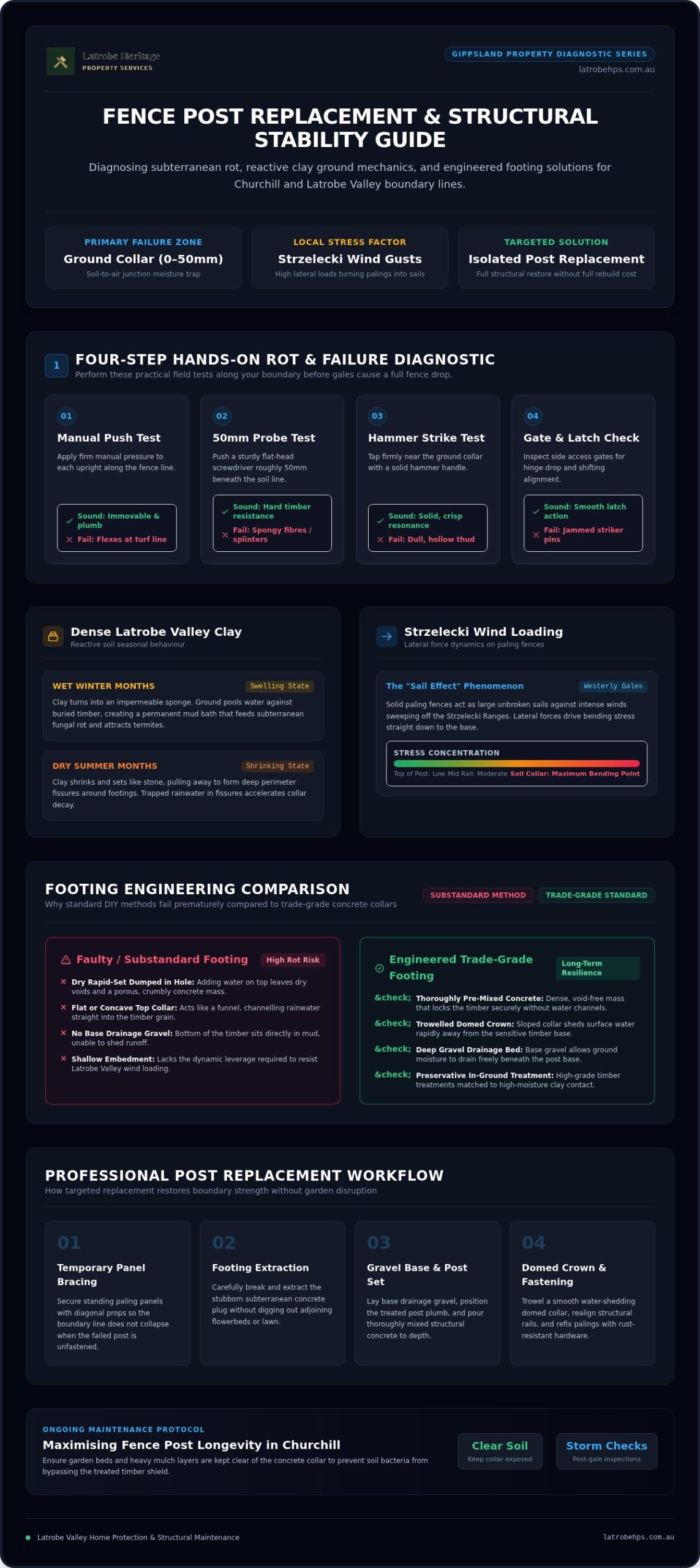
A boundary fence rarely fails overnight. It signals trouble long before it collapses onto the grass. Walk along your boundary and give each upright a firm push. A sound post stays rigid, immovable, and plumb. If an upright flexes at the turf line or wobbles inside its footing, the subterranean timber has surrendered. When posts lose their grip, the entire line begins leaning into your neighbour’s yard.
You can also spot trouble right at your side access gates. Sagging rails and shifting hinge uprights throw striker pins completely out of alignment, causing latches to jam. Most structural failures happen right at the soil-to-air junction. This narrow band of timber experiences constant exposure to soil bacteria, dampness, and trapped moisture. For home owners evaluating the need for professional fence post replacement Churchill properties benefit from a proper hands-on inspection before minor lean turns into a dropped boundary.
Detecting Below-Ground Timber Rot and Decay
Surface appearances can be deceiving. An aged post often looks respectable above ground while decaying completely out of sight. Grab a sturdy flat-head screwdriver and probe the timber roughly fifty millimetres beneath the soil line. If the steel pushes effortlessly into spongy wood fibres or pulls away crumbly splinters, structural integrity is lost. Tap the base firmly with a hammer handle; decayed posts produce a dull, hollow thud rather than a solid strike. Surface lichen and green moss are harmless, but true fungal rot softens the grain and eats the core. Standard wood preservation techniques slow this breakdown, but older posts eventually succumb once subterranean protection fails.
Wind Loading and Storm Impact in the Latrobe Valley
Churchill properties face harsh seasonal weather patterns. Intense westerly wind gusts sweep straight off the Strzelecki Ranges, applying immense lateral pressure against residential fences. A solid paling fence acts like a large sail. Wind loads drive straight down the timber uprights, concentrating maximum bending stress precisely at the ground collar. If local clay has softened the base, an aged post simply snaps off cleanly during a sudden gale. Inspect your fence line after wild weather, or walk through our practical checklist for storm-damaged timber fences to determine if a targeted fence post replacement Churchill service is needed to secure the boundary.
Why Timber Posts Fail Prematurely in Local Churchill Soils
Fencing across Gippsland faces ground conditions very different from sandy coastal strips. Churchill sits over dense, reactive clay. When dry, this ground sets like stone; when soaked, it turns into an impermeable sponge. Water cannot drain away naturally. Instead, it pools against buried timber, starving it of air and inviting hungry subterranean fungi. Without proper ground prep, the base of an upright lives in a permanent mud bath. Subterranean termites and wood-boring insects seek out these damp zones, hollowing out timber cores well before any damage shows above the grass line. When structural timber rots below the surface, executing a durable fence post replacement Churchill properties need comes down to understanding what happens underfoot.
The Threat of Heavy Latrobe Valley Clay
Latrobe Valley clay undergoes aggressive seasonal movement. Wet winter months cause the soil to swell, pushing heavily against buried concrete. Come summer, that same clay shrinks and pulls away, opening deep perimeter fissures. These ground shifts loosen footings, allowing posts to rock under wind pressure. Trapped moisture inside these fissures sits around the timber collar for months. Without a deep gravel drainage bed beneath the hole, the bottom of the post cannot shed runoff, rotting out the base from the bottom up.
Substandard Concrete Collars and Footing Errors
Poor workmanship ruins good timber. Many handymen dump dry, rapid-set concrete into an augered hole, add a splash of water, and leave it. This creates a porous, crumbly mass full of dry voids. Water penetrates straight through, remaining trapped against the wood. Even worse, flat or concave concrete tops act like small funnels, directing rain straight into the timber core. Concrete must always be mixed thoroughly and trowelled into a smooth, domed crown that sheds surface runoff away from the grain. Correct post depth is equally non-negotiable; shallow footings lack the leverage to resist Gippsland gales. Research on proper fencing installation and safety shows that ground embedment depth and solid footing technique dictate whether an upright withstands dynamic lateral loading over its working life.
If you suspect subterranean movement or poor footings are undermining your boundary, getting an honest assessment from a reliable local tradesman makes all the difference. Reach out to Latrobe Heritage Property Services for straightforward advice on securing your property boundary properly.
Repair vs Replacement: Deciding the Best Course for Your Fence
Homeowners often assume a leaning fence requires tearing down the entire boundary line. That assumption is usually wrong and unnecessarily expensive. If your horizontal rails are straight, unbowed, and securely gripping sound palings, you don’t need a whole new fence. You simply need to restore the structural skeleton underneath. A full replacement makes sense only when the rails have rotted through, palings are cupping severely, and multiple consecutive posts have failed. To evaluate your property layout accurately, check out our practical guide to fixing your boundary in Churchill before committing to major works.
The Reality of Post Brackets and Timber Sistering
Hardware stores sell bolt-on steel repair spurs and timber sistering brackets marketed as effortless weekend fixes. In reality, these are short-term bandages. Driving a metal spike into the dirt alongside a rotted post creates three immediate problems:
- Bolting fresh timber to a rotted core fast-tracks fungal decay into the new wood.
- Steel spurs lack the mass and footing depth to handle strong lateral wind loads.
- Heavy Churchill clay works spiked brackets loose after a single wet season.
Sistering brackets work fine for low garden partitions. On a full-height boundary fence, they rarely survive the next winter storm. You end up paying for a temporary patch, only to fund a permanent extraction months later.
When Individual Post Replacement Makes Financial Sense
Targeted replacement is the smartest investment when rot is isolated to one or two positions. Heavy vehicular knocks, poor local drainage, or tree root pressure can rot out a single timber upright while the rest of the span remains rock solid. Gate posts are classic culprits; carrying the dynamic swing weight of an external gate causes them to fatigue faster than intermediate uprights.
By bracing the standing bays, knocking out the rusted fixings, and digging out the failed footing, a tradesman can install a fresh post without dismantling adjoining panels. This keeps your yard secure, minimises boundary disruption with your neighbours, and avoids thousands in unnecessary materials. For an upfront, practical assessment of what can be salvaged, consult an experienced fencing contractor in Churchill who will tell you honestly whether targeted fence post replacement Churchill repairs will stand the test of time.
The Professional Step-by-Step Fence Post Replacement Process
Replacing an isolated post without wrecking the surrounding fence takes patience and technique. Rushing the job leads to split rails, cracked palings, and crooked boundaries. When tackling fence post replacement Churchill properties require methodical extraction and solid ground anchoring to ensure the restored section withstands high winds for decades.
Safely Bracing and Dismantling Fence Bays
Never knock out a damaged post while the fence panels are under load. Start by setting sturdy diagonal timber props on both sides of the adjacent bays, staking them firmly into the lawn. With the weight supported, gently lever the palings away using a wide flat pry bar. Work steadily to avoid splitting aged timber. Once the palings are off, back out the rusted fasteners holding the horizontal rails to the failed post. Detach the rails cleanly, leaving the adjoining bays fully upright and secure.
Extracting the Old Footing and Digging the Hole
A rotted post often leaves a massive, stubborn concrete plug locked inside heavy clay. Removing it requires real physical effort:
- Dig a trench around the perimeter of the existing concrete plug using a narrow trenching shovel.
- Drive a heavy-duty steel digging bar down the side of the mass to lever the plug free.
- Use a mechanical post puller or farm jack chained to the plug if the suction in damp clay resists manual leverage.
- Clean out the hole and bore down at least 600 millimetres to provide strong resistance against side-wind leverage.
Setting the New Post and Rebuilding the Bay
Drop 50 millimetres of coarse gravel into the base of the hole to allow trapped groundwater to escape. Position an H4 treated timber post or heavy-duty galvanised steel upright into the centre, checking plumb with a spirit level on two adjacent faces. Pour thoroughly mixed concrete into the hole, rodding it with a bar to eliminate air pockets. Shape the wet concrete into a raised, domed crown at ground level so surface water runs straight off the timber. Once cured, reattach the horizontal rails and secure the palings with galvanised ring-shank fencing nails that won’t pull loose. For guaranteed boundary stability without the physical strain of heavy excavation, request a quote from Latrobe Heritage Property Services to get your fence repaired directly by a trusted local tradesman.
Maximising Fence Post Longevity on Churchill Properties
Keeping a timber boundary upright for twenty years isn’t luck; it’s deliberate maintenance and sound material choice. Never pile garden mulch, lawn clippings, or compost directly against timber uprights. Doing so creates a moisture bridge, allowing soil dampness to bypass the concrete collar and soak straight into the timber grain. Keep a clean air gap beneath your bottom rails so wet turf can’t wick water upward into the palings. Simple spoon drains or gravel trenches along sloping boundaries also prevent surface runoff from pooling around footing collars during sodden Gippsland winters.
Acreage blocks face different challenges than standard suburban yards. For larger boundaries bordering paddocks or bush tracks, selecting posts suitable for rural fencing in the Latrobe Valley ensures your boundary lines stay stock-proof and solid against fallen limbs.
Choosing the Right Materials: H4 Pine vs Hardwood vs Steel
Your choice of post material dictates how often you deal with boundary repairs. Never put H3 treated timber in the dirt; it’s only rated for above-ground use and rots quickly beneath the grass. H4 treated pine provides the deep preservative treatment required to resist soil moisture, fungal rot, and termite activity. Hardwoods deliver dense structural strength and classic appeal, though they require careful pre-drilling to prevent splitting. In low-lying Churchill pockets where heavy clay stays permanently wet, galvanised steel posts eliminate subterranean rot entirely, anchoring your fence with total rigidity.
Working with Latrobe Heritage Property Services
When you need a durable fence post replacement Churchill properties can count on, dealing directly with a local owner-operator makes all the difference. Latrobe Heritage Property Services doesn’t use subcontractors, corporate middlemen, or high-pressure sales tactics. Dean assesses your boundary in person, provides straightforward advice on whether a targeted repair suffices, and completes every post installation himself. That hands-on approach ensures correct footing depths, proper drainage collars, and solid craftsmanship across Churchill, Morwell, and Traralgon.
Secure Your Boundary with Lasting Peace of Mind
A leaning timber fence doesn’t have to mean an expensive, disruptive rebuild. Catching below-ground rot early preserves your sound rails, saves undamaged palings, and protects your yard. Deep footings and properly domed concrete collars counteract reactive clay, ensuring your boundary resists the harshest Latrobe Valley weather. When an upright gives way, a targeted fence post replacement Churchill property owners can rely on restores total structural stability without dismantling the entire fence line.
Dean from Latrobe Heritage Property Services provides honest, straightforward advice on whether repairing or rebuilding your boundary fence makes the best practical sense. As a fully insured, dependable local tradesman, Dean handles every job personally on-site with zero subcontractors and zero corporate runaround. Protect your boundary before the next seasonal storm rolls through. Get a free, no-obligation fence repair quote from Dean and enjoy a sturdy, dependable boundary line built to last.
Frequently Asked Questions
Can you replace just one fence post without replacing the entire fence?
Yes, you can replace a single damaged post while leaving the rest of the fence intact. If horizontal rails and palings are sound, Dean props the adjoining bays, uncouples the rails, and excavates the rotted base. A targeted fence post replacement Churchill property owners choose saves thousands compared to full fence reconstruction, keeping your yard secure without unnecessary boundary disruption.
How deep should a fence post hole be dug in Churchill clay soil?
Fence post holes in Churchill clay should be dug to a minimum depth of 600 millimetres. For taller boundary fences or heavy gate uprights, digging down 700 to 800 millimetres provides necessary anchorage. Going deep anchors the post into stable subsoil below surface moisture shifts, counteracting the natural swell and shrinkage of Latrobe Valley clay while resisting fierce Strzelecki Range wind loads.
What timber treatment grade is required for fence posts placed in the ground?
Posts embedded in the ground require a minimum hazard class rating of H4. Never use H3 timber in the dirt; it’s chemically treated only for outside, above-ground applications like rails and pickets. H4 treated pine withstands direct ground contact, persistent soil moisture, and fungal decay. Using anything less in damp Gippsland earth ensures the post will rot out within a few short seasons.
Why do wooden fence posts always seem to break at ground level?
Timber posts snap at ground level because that specific spot combines moisture, oxygen, and maximum mechanical leverage. Wood-decaying fungi thrive right where damp soil meets fresh air. This softens the outer timber fibres over time. When lateral storm winds push against the fence palings, all the bending stress concentrates directly at the fulcrum point where the timber enters concrete, snapping the weakened upright.
Should concrete around a fence post sit above or below the soil line?
Concrete footings should always extend slightly above the surrounding soil line. When concrete finishes below soil level, dirt covers the collar, holding garden moisture and bacteria directly against the post. Finishing the concrete 25 to 50 millimetres above grade and trowelling it into a smooth dome directs rainwater away from the wood. This simple finishing step prevents water pooling and dramatically extends timber service life.
How long does a professionally replaced timber fence post typically last?
A professionally installed H4 treated timber post typically lasts between 15 and 25 years. Achieving this lifespan depends entirely on correct installation. Setting the post over a drainage gravel bed, using thoroughly mixed concrete, and shaping a water-shedding collar protects the grain. When Dean carries out a professional fence post replacement Churchill yards gain decades of boundary stability, even in wet local clay conditions.
Will replacing a fence post damage my neighbour’s garden or lawn?
A careful tradesman can replace an upright with minimal to zero disruption to neighbouring yards. Because Dean works on-site personally without subcontractors, each extraction is managed methodically. The adjacent panels are braced from within your boundary, and the concrete plug is loosened carefully using manual bars and jacks. Any excavated clay is bucketed away cleanly, protecting neighbouring garden beds, lawn turf, and boundary plantings.